
Wednesday, September 06, 2006
No internet for awhile
My roommate ordered internet from Shaw Cable on their web site over two weeks ago but did not get any response. In total he's spent three hours on the phone with Shaw and Telus, mostly on hold, getting slowly passed around the beurocracy, and has now been told by Shaw that we can have internet next Wednesday, Sept. 13.
It's as though the strategy of the two main broadband providers for getting new customers is simply to hope that the other company is even slower!


Tuesday, September 05, 2006
Disappointed about Lessig
Lawrence Lessig is a great man. He fought against the 1998 retroactive copyright extension in the U.S. supreme court, and he has been central in the movement to make copyright law more reasonable.
But I must admit some disappointment that we disagree in some fundamental way, though I'm not sure in what way precisely. As I was reading his book, Free Culture, I noticed that he referred, over and over, to "intellectual property" (IP) as "property". As I've said, I strongly disagree with the conflation of "intellectual" and "physical" property: they are not the same at all. Their properties are hardly related; logic that applies to one rarely applies to the other. I was surprised that he made little distinction between the two. Personally, I use the term "intellectual property" only because English doesn't offer another term. If it were up to me, intellectual property would have its own unique word, "yatterdote" or "tokentine" or "wektution" or something, because it is a unique beast, distinct from any other concept. Our laws, seemingly more and more, conflate the two forms of property; I wasn't expecting Dr. Lessig to contribute to the phenomenon.
Something I find interesting in the book is his eagerness to condemn "piracy", while leaving the concept of piracy vague.
But I have a little problem with his moral solidarity on the matter of commercial piracy:
Setting that issue aside, I'm troubled by the way he justifies his statement:
Then he says pirates in Asia are doing something unquestionably wrong, morally and legally, because there are laws in Asia against piracy. I'm already starting to disagree, since I don't believe that the law per se dictates what is moral and immoral. That is backwards. Rather, it should be morality that guides the law. But as Lessig admits in the very same paragraph, the local laws in Asia were imposed on them. They were imposed by such treaties as the WTO's TRIPS Agreement. While the individuals who wrote it and backed it may be hard to determine, it was clearly created and imposed by western interests, interests that do not want the people of poorer countries to enjoy the lower prices that gave the United States such a boost more than a century ago. The way international organizations like the WTO impose their power over the laws of eastern and southern countries makes it ironic when Lessig says this:
I'm not saying that commercial piracy is ever the right thing to do. I remain uncomfortable with the idea, and I myself would never commit commercial piracy, nor would I knowingly pay a pirate for a commercial work. But I live in Canada, a rich country, and now that I have money, I can generally afford to buy my software at full price. When it comes to poor countries, I am very reluctant to judge them. Lessig is not. Although he says...
Speaking of God, I am reminded that Dr. Lessig is an athiest:
Many would agree with me here.
The issue of entertainment materials is less clear, because the fact is that no one truly "needs" entertainment to survive. Nevertheless, I am reluctant to condemn CD/DVD pirates, even commercial ones, because I am sure that if they were eradicated, the copyright holders would charge far higher prices, even in very poor countries. This would greatly reduce the amount of materials that poor people could enjoy, even though it would not raise the bottom lines of U.S. corporations or artists or filmmakers very much. Although movies and music are unnecessary for anyone's survival, I think they can make life more fun. If you accept this, then you must wonder why poor people should not be allowed to enjoy what rich people can enjoy, even though it is practical for them to do so. Have they done something wrong? Are we better than them?
I do not think we are better than them, nor do I think that what they have (namely, cheap creative works) should be taken away from them, unless they themselves wish it. But their copyright laws were not designed by them. They were designed by westerners.
Thus, an enticing argument exists that whether pirates are wrong or not, U.S. copyright holders are actually in the wrong by charging excessive prices and attempting to deny poor people access to materials that they could otherwise enjoy. In the context of my central moral principle, they are doing wrong because they effectively hurt the poor, and hurting others is wrong. Now, this argument has cracks in it, but I do think there is some truth in it too.
You might suppose I'm a Robin Hood. But I don't advocate stealing from the rich to give to the poor; I only advocate giving to the poor. You see, where Dr. Lessig sees taking, I see only copying. In my mind, there is a world of difference, and I am disappointed that Dr. Lessig does not properly acknowledge it.
Nevertheless, his book is a great read. It brings to light the ways in which IP laws, corrupted by corporate influence, can harm our freedoms and our culture. It tells interesting stories. It shows us how the legal battles created by today's technology mirror the battles of the past. It shows how today's culture and technology wars are the same as those of the past, and it also shows how today's battles are different. It helps us see that creativity is not an isolated phenomenon--creative people always build on top of the work of others, though our laws don't account for this fact. It teaches the meaning and value of free culture.
Most importantly, I hope that this book will make you realize that more than ever before, it is we of the general public who are on the front lines in today's culture war. Our enemies are large corporations and corrupt politicians. It is we, of the internet generation, who must fight it. If we do not fight the culture war, we will lose it.
By the way, I'm less than 1/3 of the way through the book. I may have more to say later...
http://www.free-culture.cc/freecontent/
But I must admit some disappointment that we disagree in some fundamental way, though I'm not sure in what way precisely. As I was reading his book, Free Culture, I noticed that he referred, over and over, to "intellectual property" (IP) as "property". As I've said, I strongly disagree with the conflation of "intellectual" and "physical" property: they are not the same at all. Their properties are hardly related; logic that applies to one rarely applies to the other. I was surprised that he made little distinction between the two. Personally, I use the term "intellectual property" only because English doesn't offer another term. If it were up to me, intellectual property would have its own unique word, "yatterdote" or "tokentine" or "wektution" or something, because it is a unique beast, distinct from any other concept. Our laws, seemingly more and more, conflate the two forms of property; I wasn't expecting Dr. Lessig to contribute to the phenomenon.
...although copyright is a property right of a very special sort, it is a property right. - Free Culture, p.64Although the text makes it clear that the two kinds of property are different, I am left with the general sense that Dr. Lessig still tends to apply physical-property thinking to IP.
Something I find interesting in the book is his eagerness to condemn "piracy", while leaving the concept of piracy vague.
I believe that "piracy" is wrong,and that the law, properly tuned, should punish "piracy," whether on or off the Internet. (p. 10)I think this is deliberate; the book explores the idea of piracy and shows through many historical examples that it is not as clear cut as many claim. To the contrary, an entire chapter of examples shows how positive technological and cultural change was facilitated by what some (including Lessig himself, if you read the book literally) called "piracy".
But I have a little problem with his moral solidarity on the matter of commercial piracy:
All across the world, but especially in Asia and Eastern Europe, there are businesses that do nothing but take others people’s copyrighted content,copy it,and sell it—all without the permission of a copyright owner. The recording industry estimates that it loses about $4.6 billion (that works out to one in three CDs sold every year to physical piracy worldwide). The MPAA estimates that it loses $3 billion annually worldwide to piracy.On the face of it, that statement is hard to disagree with--except for the figures, of course. A great many bloggers have rebuked the MPAA and RIAA for their piracy loss figures, which generally appear to have come from thin air. But I'll give Lessig the benefit of the doubt and assume that these figures are reasonable, since it is their internet piracy figures that are generally considered suspect.
This is piracy plain and simple. Nothing in the argument of this book, nor in the argument that most people make when talking about the subject of this book, should draw into doubt this simple point: This piracy is wrong. (p. 63)
Setting that issue aside, I'm troubled by the way he justifies his statement:
Which is not to say that excuses and justifications couldn’t be made for it. We could, for example, remind ourselves that for the first one hundred years of the American Republic, America did not honor foreign copyrights. We were born, in this sense, a pirate nation. It might therefore seem hypocritical for us to insist so strongly that other developing nations treat as wrong what we, for the first hundred years of our existence, treated as right.Now here's where I say "wait a minute". The professor seems to be saying that the "pirated" book market that existed in the U.S. over a hundred years ago was O.K., because there was no law against it. And whether this is his view or not, it should be noted that many who lived at the time welcomed the pirated book market because it promoted learning as well as giving people broader access to entertainment (remember, books were the tool of choice to entertain oneself at the time.)
That excuse isn’t terribly strong. Technically, our law did not ban the taking of foreign works. It explicitly limited itself to American works. Thus the American publishers who published foreign works without the permission of foreign authors were not violating any rule. The copy shops in Asia, by contrast, are violating Asian law. Asian law does protect foreign copyrights, and the actions of the copy shops violate that law. So the wrong of piracy that they engage in is not just a moral wrong, but a legal wrong, and not just an internationally legal wrong, but a locally legal wrong as well. True, these local rules have, in effect, been imposed upon these countries. No country can be part of the world economy and choose not to protect copyright internationally. We may have been born a pirate nation, but we will not allow any other nation to have a similar childhood.
Then he says pirates in Asia are doing something unquestionably wrong, morally and legally, because there are laws in Asia against piracy. I'm already starting to disagree, since I don't believe that the law per se dictates what is moral and immoral. That is backwards. Rather, it should be morality that guides the law. But as Lessig admits in the very same paragraph, the local laws in Asia were imposed on them. They were imposed by such treaties as the WTO's TRIPS Agreement. While the individuals who wrote it and backed it may be hard to determine, it was clearly created and imposed by western interests, interests that do not want the people of poorer countries to enjoy the lower prices that gave the United States such a boost more than a century ago. The way international organizations like the WTO impose their power over the laws of eastern and southern countries makes it ironic when Lessig says this:
If a country is to be treated as a sovereign, however, then its laws are its laws regardless of their source. The international law under which these nations live gives them some opportunities to escape the burden of intellectual property law. In my view, more developing nations should take advantage of that opportunity, but when they don’t, then their laws should be respected. And under the laws of these nations, this piracy is wrong. (p. 64)The irony is that international law can sometimes be a tyrant, bypassing sovereignty. In the case of TRIPS, some people have made a convincing case that it has.
I'm not saying that commercial piracy is ever the right thing to do. I remain uncomfortable with the idea, and I myself would never commit commercial piracy, nor would I knowingly pay a pirate for a commercial work. But I live in Canada, a rich country, and now that I have money, I can generally afford to buy my software at full price. When it comes to poor countries, I am very reluctant to judge them. Lessig is not. Although he says...
Alternatively, we could try to excuse this piracy by noting that in any case, it does no harm to the industry. The Chinese who get access to American CDs at 50 cents a copy are not people who would have bought those American CDs at $15 a copy. So no one really has any less money than they otherwise would have had. (p. 64)...he later dismisses the argument by saying:
But where the law does not give people the right to take content, it is wrong to take that content even if the wrong does no harm.And it's here where I must protest most strongly, or where I would protest, if I wasn't confused. What exactly does he mean by "wrong"? I think the word "wrong", used without qualification, suggests a moral wrong. But his argument against poor-people piracy seems to hinge on the law. Is he saying it is morally wrong to do something that hurts no one, if the law prohibits it? Putting it in another context, is it morally wrong to roll a stop sign when there is no one else around? Should God have sharp words for you about it when you get to the pearly gates? Dr. Lessig should have seen that this argument is not strong enough to accept at face value, yet there it is in the text without any further justification. That's what puzzles me, as Dr. Lessig is a lawyer and tends to be more thorough.
Speaking of God, I am reminded that Dr. Lessig is an athiest:
I don’t believe in gods, digital or otherwise.This in turn makes me wonder how he defines "morally wrong". If it isn't God that dictates what is right and what is wrong, then there must be some other principle guiding the judgement. I don't know what his guiding principle is, but I can tell you mine. If God is set aside, my personal idea of morality is that hurting others is wrong, and benefitting others is good. This principle, in my mind, overrides all others. While Dr. Lessig eagerly condemns the pirate, regardless of the circumstances, I take note that when someone is poor, buying copyrighted works at the price fixed by a rich western corporation may be very difficult. It is often impossible for a poor person to pay full price for every work he wants; indeed, even paying for a few works may require a large sacrifice on his part. As a result I see a moral conflict where Dr. Lessig sees none. While I don't question the idea that artists deserve to get paid, I do have a sense of morality that is apparently opposed to Dr. Lessig. When I see that third world children learn less because they cannot afford textbooks, I see a wrong. Not a wrong against copyright holders, but against the children. I see a wrong committed by copyright interests, whereas Dr. Lessig, in his book, does not.
Many would agree with me here.
The issue of entertainment materials is less clear, because the fact is that no one truly "needs" entertainment to survive. Nevertheless, I am reluctant to condemn CD/DVD pirates, even commercial ones, because I am sure that if they were eradicated, the copyright holders would charge far higher prices, even in very poor countries. This would greatly reduce the amount of materials that poor people could enjoy, even though it would not raise the bottom lines of U.S. corporations or artists or filmmakers very much. Although movies and music are unnecessary for anyone's survival, I think they can make life more fun. If you accept this, then you must wonder why poor people should not be allowed to enjoy what rich people can enjoy, even though it is practical for them to do so. Have they done something wrong? Are we better than them?
I do not think we are better than them, nor do I think that what they have (namely, cheap creative works) should be taken away from them, unless they themselves wish it. But their copyright laws were not designed by them. They were designed by westerners.
Thus, an enticing argument exists that whether pirates are wrong or not, U.S. copyright holders are actually in the wrong by charging excessive prices and attempting to deny poor people access to materials that they could otherwise enjoy. In the context of my central moral principle, they are doing wrong because they effectively hurt the poor, and hurting others is wrong. Now, this argument has cracks in it, but I do think there is some truth in it too.
You might suppose I'm a Robin Hood. But I don't advocate stealing from the rich to give to the poor; I only advocate giving to the poor. You see, where Dr. Lessig sees taking, I see only copying. In my mind, there is a world of difference, and I am disappointed that Dr. Lessig does not properly acknowledge it.
Nevertheless, his book is a great read. It brings to light the ways in which IP laws, corrupted by corporate influence, can harm our freedoms and our culture. It tells interesting stories. It shows us how the legal battles created by today's technology mirror the battles of the past. It shows how today's culture and technology wars are the same as those of the past, and it also shows how today's battles are different. It helps us see that creativity is not an isolated phenomenon--creative people always build on top of the work of others, though our laws don't account for this fact. It teaches the meaning and value of free culture.
Most importantly, I hope that this book will make you realize that more than ever before, it is we of the general public who are on the front lines in today's culture war. Our enemies are large corporations and corrupt politicians. It is we, of the internet generation, who must fight it. If we do not fight the culture war, we will lose it.
By the way, I'm less than 1/3 of the way through the book. I may have more to say later...
http://www.free-culture.cc/freecontent/
Wednesday, August 30, 2006
Dictionary is going down
The dictionary server at qwertie.net, running on my home computer, is going down because my best friend and I are moving. We have to move out tomorrow (Aug. 31) in the morning, and move in Sept. 1, in the afternoon. That means there will be at least two days of downtime. Sorry for any inconvenience.
Oh, and also, we don't have an ISP at our new place yet. That could spell trouble...
Update (Sept. 5): it's still down. We don't have internet access yet.
Tuesday, August 01, 2006
My first transit ticket
I wouldn't have thought that my first post in so long would be me complaining about a ticket. But I must protest.
This morning a pair of transit cops were waiting at the train station, checking proofs of fare payment. My heart sank as I looked at my watch: I had forgotten it was August 1st, I still had a July bus pass. Now perhaps it's just terrible luck, but I'm suspicious. On my internship ending a year ago, I had been taking the C-train every day for a year (though only for two stops), and I have also taken the C-train about 20 stops every day--but only twice in all that time has my fare been checked: today, and again about two weeks ago.
So they gave me a ticket for $150.
It seems to me like a classic case of fundraising. It's like placing a speed camera at the bottom of a hill to catch speeders, on a straight road, when road conditions are perfect and visibility is ten miles. It's like the ticket my brother was given in Nevada, for rolling a stop sign in the middle of nowheresville.
It may be technically legal, but in my mind it's wrong. When I showed them my July pass, they must have known that statistically, I was a faithfully paying customer. And, of course, I was and am. Almost everyone that has a monthly pass is planning to buy another one, but they pretended not to know that as I questioned them about the matter. I asked one of them repeatedly how many tickets he gave on a typical morning of the first of the month, but he would only tell me how many he gave on a typical day: 6. Well, he was giving out tickets to two people on the train I was on (myself and a young woman who also had a July pass), and if that rate kept up during both rush hours, he would probably give out out at least 50 tickets for the day.
They asked for ID and it took awhile to find a photo in my messy wallet. I explained that I had just moved out and did not have anything with my new address on it in my wallet. I gave them my name, new cell phone number, date of birth (he asked for it twice), and new address, and when I told him I did not know my new postal code, he responded:
I then rode to the edge of an empty parking lot and cried. I'm not entirely sure why.
It's not really about the money, except that as a frugal individual I hate to have a hefty chunk of change taken from me. Perhaps what really made me sad was the principle of the thing. It's just wrong to give tickets to people on the first of the month, when they have a pass from the previous month, especially in the morning. They pretended not to see it, but they know that what they really fined me for is absent mindedness. When I was going to high school, the bus drivers had mercy--heck, this situation seemed to come up at the beginning of almost every month. I have always been and will always be forgetful--and isn't everyone, at least sometimes?
If I see these guys again on the first of the month, assuming I actually have proof of fare, I hope I can gather the courage to give them a piece of my mind. There will be no question who has the moral high ground then. But I'm usually too timid in person.
I saw a movie recently called "Pay it Forward", about a boy who does good deeds for three people and then tells them to "pay it forward", rather than pay it back, to another three people. I wonder if those transit cops ever had this happen to them. Perhaps they've been through this themselves, and they felt it was their chance to "pay it forward" this morning.
This morning a pair of transit cops were waiting at the train station, checking proofs of fare payment. My heart sank as I looked at my watch: I had forgotten it was August 1st, I still had a July bus pass. Now perhaps it's just terrible luck, but I'm suspicious. On my internship ending a year ago, I had been taking the C-train every day for a year (though only for two stops), and I have also taken the C-train about 20 stops every day--but only twice in all that time has my fare been checked: today, and again about two weeks ago.
So they gave me a ticket for $150.
It seems to me like a classic case of fundraising. It's like placing a speed camera at the bottom of a hill to catch speeders, on a straight road, when road conditions are perfect and visibility is ten miles. It's like the ticket my brother was given in Nevada, for rolling a stop sign in the middle of nowheresville.
It may be technically legal, but in my mind it's wrong. When I showed them my July pass, they must have known that statistically, I was a faithfully paying customer. And, of course, I was and am. Almost everyone that has a monthly pass is planning to buy another one, but they pretended not to know that as I questioned them about the matter. I asked one of them repeatedly how many tickets he gave on a typical morning of the first of the month, but he would only tell me how many he gave on a typical day: 6. Well, he was giving out tickets to two people on the train I was on (myself and a young woman who also had a July pass), and if that rate kept up during both rush hours, he would probably give out out at least 50 tickets for the day.
They asked for ID and it took awhile to find a photo in my messy wallet. I explained that I had just moved out and did not have anything with my new address on it in my wallet. I gave them my name, new cell phone number, date of birth (he asked for it twice), and new address, and when I told him I did not know my new postal code, he responded:
"You're only making it worse for yourself."Jeez! I'm not sure what that meant, but I'm a longtime paying customer, and if I hadn't been feeling sad at that moment, a statement like that would have made me steaming mad. Instead, having taken the ticket, I slowly pushed my bike up the steps--the escalator having been taken offline--rode to the nearest store and bought two books of bus tickets.
I then rode to the edge of an empty parking lot and cried. I'm not entirely sure why.
It's not really about the money, except that as a frugal individual I hate to have a hefty chunk of change taken from me. Perhaps what really made me sad was the principle of the thing. It's just wrong to give tickets to people on the first of the month, when they have a pass from the previous month, especially in the morning. They pretended not to see it, but they know that what they really fined me for is absent mindedness. When I was going to high school, the bus drivers had mercy--heck, this situation seemed to come up at the beginning of almost every month. I have always been and will always be forgetful--and isn't everyone, at least sometimes?
If I see these guys again on the first of the month, assuming I actually have proof of fare, I hope I can gather the courage to give them a piece of my mind. There will be no question who has the moral high ground then. But I'm usually too timid in person.
I saw a movie recently called "Pay it Forward", about a boy who does good deeds for three people and then tells them to "pay it forward", rather than pay it back, to another three people. I wonder if those transit cops ever had this happen to them. Perhaps they've been through this themselves, and they felt it was their chance to "pay it forward" this morning.
Saturday, June 10, 2006
Dictionary Down
My interdictionary project server is down because the primary Windows partition somehow got corrupted (while I was using the computer ... that was an interesting experience.)
I sure hope that the database was not being stored on that partition, but I don't remember. Linux is still working and I will hopefully have it back up in the next day or two.
Update: The dictionary is back up with a new database. If the server is unreachable, please notify me (qwertie256@yahoo.com).
Tuesday, June 06, 2006
Hacktivism
A couple articles I've seen today make me wonder what it is certain authorities think is so horrible about hacking. Seems like when they catch one--a seemingly rare event--they want to "make an example" of him. Kevin Mitnick is probably the best-known example; he served 5 years in prison, but what did he actually do, and of what was he convicted? From what I've read, not that much. Real-life network hackers aren't like hackers in hollywood movies; for the most part they're just regular people who are far too curious for their own good.
Today I saw this article about Gary McKinnon.
And that's the issue I want to bring up: was McKinnon a hacker or a cracker? The law might not make a distinction, but to me it's very important to consider an individual's intentions. If all McKinnon did was snoop around military networks out of curiosity, and never did anything with the knowledge so gained, can he be considered any worse than any of the crackers, spammers, and scammers infesting the internet these days?
Tentatively, this sounds like a minor crime at worst. It seems to me that the real story here is not some guy that pokes his nose where it doesn't belong; rather we should be disturbed that a single individual was able not only to hack into and explore the Army's, Navy's, Air Force's and DoD's networks, but that he was not caught for "years". This is the biggest and by far the most expensive military in the world--and they can't keep people out of their networks? Yeesh.
I saw another hacking story today. Three of the more traditional hackers (programmers) are trying to help people circumvent the great firewall of China.
Today I saw this article about Gary McKinnon.
The US government alleges that between February 2001 and March 2002, Mr McKinnon repeatedly hacked into dozens of computers used by the US Army, Navy, Air Force, and Department of Defense.I'm inclined to believe him, since I have a little bit of that spirit myself. Actually, the term "hacker" used to refer specifically to a self-motivated programmer, before hollywood and others appropriated the term to mean "one who breaks into computer networks". Indeed, the word is still used in that sense today in the free software and Linux worlds, and I think the two kinds of hackers are similar kinds of people. But don't confuse hackers with crackers, who are malicious hackers.
While Mr McKinnon has admitted that he spent years wandering round military computer networks, he denies that his hacking was ever motivated by anything other than curiosity.
And that's the issue I want to bring up: was McKinnon a hacker or a cracker? The law might not make a distinction, but to me it's very important to consider an individual's intentions. If all McKinnon did was snoop around military networks out of curiosity, and never did anything with the knowledge so gained, can he be considered any worse than any of the crackers, spammers, and scammers infesting the internet these days?
Tentatively, this sounds like a minor crime at worst. It seems to me that the real story here is not some guy that pokes his nose where it doesn't belong; rather we should be disturbed that a single individual was able not only to hack into and explore the Army's, Navy's, Air Force's and DoD's networks, but that he was not caught for "years". This is the biggest and by far the most expensive military in the world--and they can't keep people out of their networks? Yeesh.
I saw another hacking story today. Three of the more traditional hackers (programmers) are trying to help people circumvent the great firewall of China.
"Hacking is an important philosophy we need to recover in our society," says Deibert, now the father of four young children, "because so many systems of control are embedded in technology, most of which we're unaware of."The more we take the screws off and understand how things work, the more we'll have citizens in control of their lives and the technological society they live in."Kudos. I don't see how they could do much against China's censorship regime, but I certainly wish them luck.
Thursday, June 01, 2006
Copy South
I'd read in a book called Information Feudalism about how the intellectual property laws of our rich countries were imposed on poor countries by an international agreement called TRIPS. This treaty, which is required to enter the WTO, hurts those countries without offering anything to them in return.
So, I was interested to hear about Copy South, which discusses the effects of copyright on the third world.
So, I was interested to hear about Copy South, which discusses the effects of copyright on the third world.
As long-time Philippines activist Roberto Verzola explained at the Copy/South workshop … there are two main competing value systems in the world and, in the current era, “the value system of monopolisation, corporatisation, and privatisation is being imposed on what I think is a better system, a system of sharing.”
From the start, it was clear to many that the TRIPS Agreement would primarily benefit already developed Northern countries far more than those in the global South. It is the multinationals of the North who already own the overwhelming percentage of ... copyright, patents, [and] trademarks; the creation, expansion, and stricter enforcement of ... intellectual property rights overwhelmingly benefits those already owning property.
Ten years have passed since TRIPS became reality ... The more common name for such treaties is ‘free trade agreements’; they follow a hypocritical (and contradictory) agenda of purporting to promote ‘freer trade’ in monopolised goods such as patented pharmaceuticals and Hollywood blockbusters. We ask, “how much ‘free trade’ in Nigerian or Cuban or Chinese films occurs within the US or Europe?” So it will be argued here that TRIPS and its component parts, such as the Berne Convention, have simply reproduced the types of economic inequalities associated with the earliest stages of colonialism and imperialism.
- The Copy/South Dossier
Has it really been that long?
It's been nearly four months since my last post. A lot had been happening in my life and it seemed like no one was reading my blog anyway. The last month of school was very hectic; in the last three weeks, I had so much to do that I withdrew from a course to reduce my workload. There were projects everywhere: the Fourth Year Design Project, the compiler project, the database project and the parallel processing project--this last project was in the course from which I had to withdraw.
In my database class we had to do a database project--a web application with a database back-end. I considered this my opportunity to finally do something I wanted to do.
The Esperanto international auxilliary language (IAL), which I've discussed before, suffers from poor-quality and incomplete English dictionaries, and I felt that a user-editable dictionary could be the solution to that problem. Wikipedia has a sister dictionary project, Wiktionary, but it's inconvenient to use Wiktionary to actually look stuff up, especially when you want a translation dictionary.
So I made qwertie.net. Note:
I should write some more entries now. I've got a new best friend, a new job, a new home, and new ideas for programs I want to write.
In the meantime, uhm, well, check out my del.icio.us bookmarks. There's lots of programming stuff but also freedom-fighting goodness... or better yet, learn from the EFF about how Big Media is having its way with the U.S. Congress:
In my database class we had to do a database project--a web application with a database back-end. I considered this my opportunity to finally do something I wanted to do.
The Esperanto international auxilliary language (IAL), which I've discussed before, suffers from poor-quality and incomplete English dictionaries, and I felt that a user-editable dictionary could be the solution to that problem. Wikipedia has a sister dictionary project, Wiktionary, but it's inconvenient to use Wiktionary to actually look stuff up, especially when you want a translation dictionary.
So I made qwertie.net. Note:
- Only the English<=>Esperanto dictionaries contain a significant number of entries.
- It doesn't work well in Internet Explorer 6; get Firefox.
- This site might not be up forever.
I should write some more entries now. I've got a new best friend, a new job, a new home, and new ideas for programs I want to write.
In the meantime, uhm, well, check out my del.icio.us bookmarks. There's lots of programming stuff but also freedom-fighting goodness... or better yet, learn from the EFF about how Big Media is having its way with the U.S. Congress:
"With so many tech mandate proposals and DRM restrictions being introduced, it's all too easy to miss how they fit together. A digital radio mandate here, an analog hole plug there, add in a little HDCP on video outputs for bad measure, and so on -- pretty soon, you've got DRM everywhere, and the whole is far more dangerous than the sum of its parts."
The Battle for Your Digital Media Devices And learn about Digital Video Restrictions
Friday, February 10, 2006
DRM is your friend - Ars
Ars Technica is a great site to read computer news and reviews, and I recently noticed they also have a solid focus on consumer rights. For example, in today's editorial on Digital Restriction Management (DRM), they criticise the MPAA for their silly claim that DRM is good for consumers. The usual claim is that "it stops piracy so that you, the consumer, will continue to enjoy our quality content", but now they've said "...it provides casual, honest users with guidelines for using and consuming content...." ahh, how good of them to "guide" consumers with restrictions that, thanks to the DMCA, are legally binding. With the "broadcast flag" and "analog hole" bills being considered, restrictions on TV and radio may soon be mandatory also, for all manufacturers.
So, I've got their RSS feed bookmarked. Other issues Ars has covered in the last week include IPTV, librarians' concerns that DRM inhibits archiving, Legalization of P2P in france, AOL & Yahoo's paid e-mail plan, the danger and utility of metadata, Blizzard Entertainment's latest heavy-handed behavior, the long tail versus the blockbuster, antitrust complaints over Microsoft Vista, the latest U.S. government plan to amass personal information, and the latest use of a software patent as a cash cow. Indeed, if there's one thing that might turn off the Average Joe or Geek to Ars Technica, it's the sheer amount of information they provide. My only complaint is that there seems to be no easy way to browse old articles.
So, I've got their RSS feed bookmarked. Other issues Ars has covered in the last week include IPTV, librarians' concerns that DRM inhibits archiving, Legalization of P2P in france, AOL & Yahoo's paid e-mail plan, the danger and utility of metadata, Blizzard Entertainment's latest heavy-handed behavior, the long tail versus the blockbuster, antitrust complaints over Microsoft Vista, the latest U.S. government plan to amass personal information, and the latest use of a software patent as a cash cow. Indeed, if there's one thing that might turn off the Average Joe or Geek to Ars Technica, it's the sheer amount of information they provide. My only complaint is that there seems to be no easy way to browse old articles.
Thursday, February 09, 2006
My first stitches
Has anyone ever threatened to "rip you a new asshole"? Well, now I know what it's like!
 Some time ago I bought a two-foot square mirror from a garage sale. I wasn't using it and Tuesday night it was resting upright against another object in my room. The side of the mirror was sticking out, which sets the stage for my tale.
I had just taken a shower and was nude in my room, standing up. Oblivious to the presence of the mirror, I quickly ducked down, perhaps to pick something up from the floor, and felt a sharp pain in the left buttock. Giving a yelp, I jumped up and onto my bed. I instinctively grabbed my behind and applied pressure, but all I felt was my own skin.
When I twisted around to look at the area, I was expecting to see some kind of scratch, but instead I was greeted with a large gash. I saw it only for a moment; I believe I saw a mix of colors inside the wound--yellow or orange, with dark red streaks. As I watched it, blood began oozing out. It occurred to me that I should put a bandage on it, so I jumped out of bed and looked frantically for my box of band-aids. Finding it after a few seconds, I pulled out a band-aid and it turned out to be one of the tiny ones. At that moment I realized I was bleeding, and blood began dripping on the carpet. I reached in the box and pulled out a regular-size one before coming to my senses: it was too small, and I'd better get out of my room before my carpet was covered in blood.
I grabbed a towel and clumsily held it in front of me as I made my way to my roommates' room. I hadn't explained to them that I was a naturist, and being a Chinese couple, I assumed they would be uncomfortable if I were nude, but I didn't want to get blood stains all over my towel. So I held it in front of me in the dark hallway when my roommate, Micheal, opened his door.
"Turn on the light," I said, since, holding the towel with both hands, I couldn't do it myself.
"What?" he responded.
"Turn...on...the light!"
So he did, and I explained I'd cut myself. His wife Karen came out also and took a look too. I asked for a bandage and he brought a small square gauze-like cloth. It got pretty awkward at that point as I tried to hold the bandage and towel in place at the same time. Soon after I felt a little lightheaded and laid on the floor.
I don't remember exactly how the conversation went, but we discussed what to do. I really wasn't sure. I didn't know if Alberta Health Care would cover getting stitches and whether they were really necessary. The cut was about 5 cm long (4.6 cm, come to measure it) and 1 cm deep; in hindsight, stitches were clearly necessary, but at the time, I thought that Micheal could use a series of band-aids to pull the two sides of the cut together. I was also worried about wait times at the hospital, and my fears were confirmed when I called Foothills. They said I would have to wait "several hours" and suggested I try the clinic on 8th and 8th. I called the clinic, which refused to give me a wait time, only saying it would be faster than the hospital.
Well, Micheal put a bunch of band-aids on it along with that gauzy thing, and we went to the clinic. We arrived around 10:40 or 11:40 (I forget), and there were only about 8 patients waiting ahead of us. Even so, to our amazement, we spent almost 4 hours in the waiting room. This was unusually unpleasant for me, since I was somewhat sitting-impaired.
I could sit, but I couldn't shuffle in my seat without a lot of pain.
Then I was called into a room with a bed and medical equipment, and waited for what seemed like a half hour before the doctor came. In the meantime, the nurse came and removed the bandages, which was certainly worse than the stitching. The operation itself was an interesting experience, though not quite worth the wait. She used local anaesthetic, which is very cool stuff. I hate to think how it would have felt without it.
 There are now ten stitches in my bum, which the doctor calls "sutures". I'll have to get them removed in six to nine days.
I had a major assignment I had to finish by 1 PM the next day, and I knew I wouldn't finish it properly by then, because I'd have to sleep in awhile. So I asked to have a doctor's note I could use for sympathy-garnering purposes. Amazingly, I was told I'd have to pay $15 for it. I didn't have to pay for the stiches*, but if I wanted a written record of getting them, it would cost me? Crazy. Do stores charge money for receipts?
So I told them to forget it.
The next day, having slept in by over two hours, I rushed to write a presentable report for my assignment. This went very smoothly overall, but I still arrived 15 minutes late for the class where I was supposed to hand it in. Luckily, however, the teacher was 20 minutes late. Ahh.
 Some time ago I bought a two-foot square mirror from a garage sale. I wasn't using it and Tuesday night it was resting upright against another object in my room. The side of the mirror was sticking out, which sets the stage for my tale.
I had just taken a shower and was nude in my room, standing up. Oblivious to the presence of the mirror, I quickly ducked down, perhaps to pick something up from the floor, and felt a sharp pain in the left buttock. Giving a yelp, I jumped up and onto my bed. I instinctively grabbed my behind and applied pressure, but all I felt was my own skin.
When I twisted around to look at the area, I was expecting to see some kind of scratch, but instead I was greeted with a large gash. I saw it only for a moment; I believe I saw a mix of colors inside the wound--yellow or orange, with dark red streaks. As I watched it, blood began oozing out. It occurred to me that I should put a bandage on it, so I jumped out of bed and looked frantically for my box of band-aids. Finding it after a few seconds, I pulled out a band-aid and it turned out to be one of the tiny ones. At that moment I realized I was bleeding, and blood began dripping on the carpet. I reached in the box and pulled out a regular-size one before coming to my senses: it was too small, and I'd better get out of my room before my carpet was covered in blood.
I grabbed a towel and clumsily held it in front of me as I made my way to my roommates' room. I hadn't explained to them that I was a naturist, and being a Chinese couple, I assumed they would be uncomfortable if I were nude, but I didn't want to get blood stains all over my towel. So I held it in front of me in the dark hallway when my roommate, Micheal, opened his door.
"Turn on the light," I said, since, holding the towel with both hands, I couldn't do it myself.
"What?" he responded.
"Turn...on...the light!"
So he did, and I explained I'd cut myself. His wife Karen came out also and took a look too. I asked for a bandage and he brought a small square gauze-like cloth. It got pretty awkward at that point as I tried to hold the bandage and towel in place at the same time. Soon after I felt a little lightheaded and laid on the floor.
I don't remember exactly how the conversation went, but we discussed what to do. I really wasn't sure. I didn't know if Alberta Health Care would cover getting stitches and whether they were really necessary. The cut was about 5 cm long (4.6 cm, come to measure it) and 1 cm deep; in hindsight, stitches were clearly necessary, but at the time, I thought that Micheal could use a series of band-aids to pull the two sides of the cut together. I was also worried about wait times at the hospital, and my fears were confirmed when I called Foothills. They said I would have to wait "several hours" and suggested I try the clinic on 8th and 8th. I called the clinic, which refused to give me a wait time, only saying it would be faster than the hospital.
Well, Micheal put a bunch of band-aids on it along with that gauzy thing, and we went to the clinic. We arrived around 10:40 or 11:40 (I forget), and there were only about 8 patients waiting ahead of us. Even so, to our amazement, we spent almost 4 hours in the waiting room. This was unusually unpleasant for me, since I was somewhat sitting-impaired.
I could sit, but I couldn't shuffle in my seat without a lot of pain.
Then I was called into a room with a bed and medical equipment, and waited for what seemed like a half hour before the doctor came. In the meantime, the nurse came and removed the bandages, which was certainly worse than the stitching. The operation itself was an interesting experience, though not quite worth the wait. She used local anaesthetic, which is very cool stuff. I hate to think how it would have felt without it.
 There are now ten stitches in my bum, which the doctor calls "sutures". I'll have to get them removed in six to nine days.
I had a major assignment I had to finish by 1 PM the next day, and I knew I wouldn't finish it properly by then, because I'd have to sleep in awhile. So I asked to have a doctor's note I could use for sympathy-garnering purposes. Amazingly, I was told I'd have to pay $15 for it. I didn't have to pay for the stiches*, but if I wanted a written record of getting them, it would cost me? Crazy. Do stores charge money for receipts?
* Well, health care isn't really free, of course; we have to pay $132 in premiums per quarter in Alberta, and one document I found pegged government health care spending at 7.0% of GDP or 18.4% of total "government outlays".
So I told them to forget it.
The next day, having slept in by over two hours, I rushed to write a presentable report for my assignment. This went very smoothly overall, but I still arrived 15 minutes late for the class where I was supposed to hand it in. Luckily, however, the teacher was 20 minutes late. Ahh.
Thursday, February 02, 2006
I'm back!
Well, it turns out my motherboard wasn't defective: all Asus P5GD1 motherboards are defective in the same way, and my replacement failed in the same way. Luckily I found a solution and reinstalled Windows. However, I was unable to install Linux. Research suggests it will only be possible if I replace my hard drives with a Serial ATA drive (or buy a different motherboard).
Linux is looking a lot better than it did six years ago when I gave up on using it. I tried a Kubuntu live CD, and was very impressed. It automatically detected my video card and ethernet port, and gave me a friendly introduction to today's Linux. Unfortunately, I can't install it because it can't see the hard drives.
Broadcast flag update
Anyway, the record industry is pushing their greedy agenda again with their latest bill. Ars Technica reports (via EFF) that there's a new bill to force hardware makers to put draconian hardware restrictions in their digital radio receivers. It's not clear to me on first read what exactly the implications are of this bill--I should edit this post later when I figure it out.
Linux is looking a lot better than it did six years ago when I gave up on using it. I tried a Kubuntu live CD, and was very impressed. It automatically detected my video card and ethernet port, and gave me a friendly introduction to today's Linux. Unfortunately, I can't install it because it can't see the hard drives.
Broadcast flag update
Anyway, the record industry is pushing their greedy agenda again with their latest bill. Ars Technica reports (via EFF) that there's a new bill to force hardware makers to put draconian hardware restrictions in their digital radio receivers. It's not clear to me on first read what exactly the implications are of this bill--I should edit this post later when I figure it out.
Saturday, January 28, 2006
Microsoft's Incompetence
I think it may be time to move to Linux.
Two weeks ago, I turned on my Windows 2000 computer and was greeted by a blue screen saying the "registry could not load the hive (file)". The usual startup modes like Safe Mode and Last Known Good gave the same error, and I was locked out of Windows.
40 hours' work and a new motherboard later, I cannot emphasize enough how moronic Microsoft is. Windows has amazingly little tolerance for failure or hardware changes.
There were at least three showstopping problems I encountered. Firstly, I had a perfectly good Windows 2000 installation on a broken computer; I tried to boot from this hard disk, but got INACCESSIBLE_BOOT_DEVICE error early in the startup process. Some research revealed that Windows keeps only a single hard disk driver installed. Because of this, if you change to a different kind of motherboard, or move a hard drive from one computer to another, Windows 2000 will be unable to access the hard drive from which it was booted. Of course, it would have been extremely easy for the Windows development team to avoid this problem, by loading a generic IDE driver to use as a fallback in case the regular driver doesn't work. By the way, there is a way to install multiple drivers, but it can only be done before changing to a new motherboard. Here you can see Microsoft's unhelpful instructions:
Secondly, Windows 2000 (or XP) offers no command prompt or built-in repair services if something goes wrong. Since the registry appeared to be corrupt, I needed to reach a console in order to attempt to restore an old registry (assuming I had one, which I wouldn't be able to determine without a console). The "Recovery Console" can be used for this purpose, but for some reason my computer could not boot from a CD-ROM (it's a long story). Now, the Recovery Console can be installed on the hard disk (as described here) so booting from the CD is unnecessary, but that is a little known fact (I never even heard of the Recovery Console before my computer broke), and of course it can only be installed before Windows breaks.
The Recovery Console, by the way, is usually fairly useless because it has very little functionality and contains severe restrictions on what you're allowed to do. Arbitrary security restrictions are not welcome when your computer is broken and you have no other recourse. Linux can be used to get around Microsoft's silly restrictions, but even after I convinced CDs to boot, my Linux live CDs were unable to mount themselves.
Thirdly, the Windows 2000 CD has a Repair option, but (surprise!) it refuses to work without an Emergency Repair Disk, and of course, you can't create an ERD floppy unless Windows 2000 is working! This is the ultimate in stupid design because
Two weeks ago, I turned on my Windows 2000 computer and was greeted by a blue screen saying the "registry could not load the hive (file)". The usual startup modes like Safe Mode and Last Known Good gave the same error, and I was locked out of Windows.
40 hours' work and a new motherboard later, I cannot emphasize enough how moronic Microsoft is. Windows has amazingly little tolerance for failure or hardware changes.
There were at least three showstopping problems I encountered. Firstly, I had a perfectly good Windows 2000 installation on a broken computer; I tried to boot from this hard disk, but got INACCESSIBLE_BOOT_DEVICE error early in the startup process. Some research revealed that Windows keeps only a single hard disk driver installed. Because of this, if you change to a different kind of motherboard, or move a hard drive from one computer to another, Windows 2000 will be unable to access the hard drive from which it was booted. Of course, it would have been extremely easy for the Windows development team to avoid this problem, by loading a generic IDE driver to use as a fallback in case the regular driver doesn't work. By the way, there is a way to install multiple drivers, but it can only be done before changing to a new motherboard. Here you can see Microsoft's unhelpful instructions:
"Although Microsoft does not support this method, you can import or merge the required registry entries, and copy the drivers beforehand to support all IDE controllers that are natively supported by Windows XP."It never seems to have crossed their minds that "copying the drivers beforehand" might not be possible.
Secondly, Windows 2000 (or XP) offers no command prompt or built-in repair services if something goes wrong. Since the registry appeared to be corrupt, I needed to reach a console in order to attempt to restore an old registry (assuming I had one, which I wouldn't be able to determine without a console). The "Recovery Console" can be used for this purpose, but for some reason my computer could not boot from a CD-ROM (it's a long story). Now, the Recovery Console can be installed on the hard disk (as described here) so booting from the CD is unnecessary, but that is a little known fact (I never even heard of the Recovery Console before my computer broke), and of course it can only be installed before Windows breaks.
The Recovery Console, by the way, is usually fairly useless because it has very little functionality and contains severe restrictions on what you're allowed to do. Arbitrary security restrictions are not welcome when your computer is broken and you have no other recourse. Linux can be used to get around Microsoft's silly restrictions, but even after I convinced CDs to boot, my Linux live CDs were unable to mount themselves.
Thirdly, the Windows 2000 CD has a Repair option, but (surprise!) it refuses to work without an Emergency Repair Disk, and of course, you can't create an ERD floppy unless Windows 2000 is working! This is the ultimate in stupid design because
- Most home users like myself don't prepare in advance for Windows to quit working, not least because we don't know how. It requires research, which doesn't feel worthwhile when your system is working fine.
- Many people don't have floppy drives (I still do, though.)
- Most importantly, the ERD is mostly unnecessary. The ERD contains three small files from your C: drive which the Win2K CD can restore if they turn out to be corrupt. However, if those three files are fine, then there is no need for the ERD. In addition to checking those three files, the repair process checks the system files on your hard disk against the correct version of the files that are on the Windows 2000 CD; this second process has no need for the ERD.
Sunday, January 22, 2006
I'm out of commission
Eight days ago my main computer stopped working, and I've been unable to fix it despite valiant efforts that might make for an amuzing geek story.
Meanwhile, school work is piling up and I won't have time to blog this coming week unless I use my time foolishly.
Friday, January 13, 2006
Coming of Age
This post is rated P for Personal. You might find it B for Boring.
I think it's really happening in earnest now: I'm really starting to appreciate that "the more I learn, the less I know." I can see now that I'll never have more than a smidgen of knowledge in every area of human endeavor; indeed, there will doubtlessly be important aspects of life whose very existance I will never hear about.
I chose to pursue the world of computers when I was younger, but the computer world grew faster than I did. I used to think I was a brilliant with computers (the grown-ups all said so); now I'm merely an above average programmer, and only in certain areas of computer science, with specific programming languages.
I started out writing programs in BASIC on the Commodore 64 and Apple II, and as far as I knew, that's what programming was. A compiler? What's that? The internet? Never heard of it.
Today, my list of things-I-wanna-learn grows ever longer--or it would, if I wrote the list down. As it is, I suspect I've forgotten more items than I remember.
In the programming field, I can write programs in C, C++, C#, VB6, Java, and as of December, Ruby. I've also had a little exposure to Pascal, MATLAB, Verilog, gnu make, and VB.NET. But I had planned to learn Python for a couple of years now and still haven't done it. There are other interesting languages I would like to learn: Perl, Lisp, Dylan, Eiffel, and conceivably Smalltalk or Objective C. But now, knowing languages is just the tip of the iceberg. Look at all the other stuff there is to learn about:
Looking beyond computers, I can see many other big fields: oil & gas, food, construction, politics & civil service, management, marketing, real estate, entertainment, education, health care, and so forth.
If I assume that other industries are as vast as the computer industries, then clearly there's no hope I'll ever know much about most of them.
I suppose it's good to know how small I am in the scheme of things, but it's a scary thought. Perhaps it's best to forget about it.
I think it's really happening in earnest now: I'm really starting to appreciate that "the more I learn, the less I know." I can see now that I'll never have more than a smidgen of knowledge in every area of human endeavor; indeed, there will doubtlessly be important aspects of life whose very existance I will never hear about.
I chose to pursue the world of computers when I was younger, but the computer world grew faster than I did. I used to think I was a brilliant with computers (the grown-ups all said so); now I'm merely an above average programmer, and only in certain areas of computer science, with specific programming languages.
I started out writing programs in BASIC on the Commodore 64 and Apple II, and as far as I knew, that's what programming was. A compiler? What's that? The internet? Never heard of it.
Today, my list of things-I-wanna-learn grows ever longer--or it would, if I wrote the list down. As it is, I suspect I've forgotten more items than I remember.
In the programming field, I can write programs in C, C++, C#, VB6, Java, and as of December, Ruby. I've also had a little exposure to Pascal, MATLAB, Verilog, gnu make, and VB.NET. But I had planned to learn Python for a couple of years now and still haven't done it. There are other interesting languages I would like to learn: Perl, Lisp, Dylan, Eiffel, and conceivably Smalltalk or Objective C. But now, knowing languages is just the tip of the iceberg. Look at all the other stuff there is to learn about:
- Libraries: Most languages now have enormous standard libraries, and every language has a community around it that produces an endless barage of useful libraries, each with its own bafflingly unique and quirky API.
- Paradigms: Aspect-Oriented Programming, Functional programming, Parallel & distributed programming, Metaprogramming, Service Oriented Architectures, Test Driven development, Extreme programming, Design patterns...
- Fields: Geographic Information Systems (GIS), Search technology, Desktop Publishing, Multimedia, Games, Scientific Computing, Embedded computing (with an endless number of sub-fields) and so forth.
- Databases: These have been important for decades, yet I still lack basic knowledge about installing and using them.
- Internet stuff: Unfortunately I don't have enough knowledge to make a big list of internet stuff, but I know enough to know that the list could go on forever. It's tough to get started in practical web programming because you have to learn at least five languages (although the first three aren't true programming languages, nor very hard): HTML, CSS, SQL, Javascript, and a server-side language of your choice; plus, you have to find a service provider that will let you use your chosen language, and figure out how to install your code on their server. Either that, or you have to figure out how to set up your own web server. It is mainly this last issue (installation) that has discouraged me from learning web programming.
Looking beyond computers, I can see many other big fields: oil & gas, food, construction, politics & civil service, management, marketing, real estate, entertainment, education, health care, and so forth.
If I assume that other industries are as vast as the computer industries, then clearly there's no hope I'll ever know much about most of them.
I suppose it's good to know how small I am in the scheme of things, but it's a scary thought. Perhaps it's best to forget about it.
Thursday, January 12, 2006
Recolored
 A formerly monochrome family
(American Nudist Leader, 1960).
A formerly monochrome family
(American Nudist Leader, 1960).
It's really useful already, but for certain situations, it would be really handy to use a customized coloring method. For instance, I've found that in several situations you might want to automatically vary the color according to the brightness of each pixel. This would be useful, for example, when coloring a tree with dark leaves against a bright sky background, when coloring certain breeds of cats, or when coloring a chain-link fence in front any colored surface. In these cases multiple colors are mixed very closely, and manual coloration is very tedius.
There are other tweaks to the algorithm that would be useful also; for example, coloration based on texture, or varying the color saturation according to brightness. A quick preview or quick color test feature would be extremely handy.
Which brings me to my talking point... if only the program were open-source, one could make the changes one wants all by oneself. One could also take the very cool coloring algorithm and insert it in other programs such as Photoshop, Paint.NET or The Gimp. Now, the wonderful world I've described before in which almost everything is open source won't become reality any time soon, but here's an idea for getting specific programs to go open source.
There is a website somewhere where people can make proposals with a monetary requirement (such as "release Recolored under the GNU GPL for $20,000") and other people can pledge money to it. But, er, I lost the address of the web site. Anyway, I wonder how many products could be coerced into freeness in this manner. If it's practical, maybe we could make a movement out of it. The movement's job would be to negotiate prices and terms with software vendors, and then to create awareness and convince people to make pledges.
Mind you, it would probably work only with a whole ton of pledges, so we'd have to rely on non-geek support. It would also require that many people who would otherwise just buy a licence be convinced to make a pledge instead (or in addition)--a tough sell, for the most part, I think.
There are other problems. Merely open-sourcing a program doesn't yield the desired features, of course. And the code quality of a closed-source app is inestimable. Are there a good set of code comments? Function- and class-level docs? It the code structured like a house drawn by Dr. Suess? There are a lot of open-source programs that don't get touched due to such issues.
In summary: this idea might suck. Still, there are probably situations where this could work.
Saturday, January 07, 2006
Looking for a girl

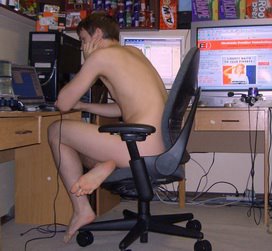 Would you like to hook up with me? I'm quite available.
I'm looking for a girl
Would you like to hook up with me? I'm quite available.
I'm looking for a girl
- Who wants to get married and have kids someday.
- Who appreciates mathematics and logic, and if I'm really lucky, computer programming and linguistics.
- Who is interested in learning about technology or is already a geek.
- Who wants to make the world a better place.
- I decided to become a naturist (yeah, not a naturalist) three years ago. Now I'm 25.
- I'm studying 4th year Computer Engineering.
- I have been programming since I was ten.
- I like to sing. People tell me I have a good voice. I would like to learn to play an instrument, but can't yet.
- I'm a member of the Church of Jesus Christ of Latter-day Saints (a Mormon).
- Fighting poverty
- Electoral reform
- Major and minor reforms to copyright law
- Banning software patents
- Eliminating language barriers in the world by taking steps that will lead to the eventual adoption of an easy and useful universal second language, also known as an international auxilliary language (IAL)
Friday, January 06, 2006
How to achieve true freedom of information
An earlier article received criticism from someone who felt that (paraphrasing) "it is wrong to get something for free when the material was not meant to be free." He gave the example of a painter who wants only a certain number of prints to be available. But, I asked, why would it be inherently pleasing to a painter for copies of his painting to be scarce?
Now, he didn't answer, and I'm not a painter, but I will venture anyway to respond that scarcity is not something that normally brings satisfaction to a creative worker. Normally, if I wrote a book, I would be glad if millions of people read it. If I were a painter, I would be glad if each of a million people hung a copy on their wall. As a programmer, I would be glad if a million people used my programs.
Indeed, nothing could make me happier than to write a program that millions of people use and find useful. Nothing, that is, except to live in a house, eat food, and someday in the future, provide for my wife and children. The problem is that these desires are at odds with each other in our present system of intellectual property.
Most people don't even realise there is a problem. They take for granted that they have to pay for books they read (unless they get it from a library); that cable costs a lot, yet is still saturated with advertising, and sometimes has nothing worth watching on 50 channels; that music comes on discs, and starts at $10 new; that some software is utterly unaffordable, yet a lot of software is free; that they can't simply watch any movie on their computer that came up on a Google search; and that if they can't afford a creative work, they have to do without, or break the law and pirate it. Most of all, they take for granted that they can't enjoy all the works they want to, even though doing so would have no negative effects beyond wasting time.
Meanwhile, authors take for granted that they have to charge money to make money, and that free use of their work can only be allowed at the expense of their own bottom line. Even the most idealistic free software developers take for granted that by giving away their source code, they cut off potential revenue sources (though often not all of them.)
Yes, these are the facts of our world as it is now. But we should realise that these things are a result of our laws and of the power structures in our society. And, thanks to the efforts of misguided diplomats, big corporations and WIPO, similar structures are in place all over the world. However, none of these things are inherently a part of the human condition, so with enough will, they can be changed.
In this article I won't try to say how to change the system, but rather how a hypothetical system might work, because right now we are stuck so firmly in the status quo that alternatives never even cross our minds. Hence, education is the order of the day. My goal is to convince you that another way is possible, so you can stop seeing the intellectual property system as a fact of life, as "a necessary evil", or as related in any way to real property.
As you read this, if you feel it is unrealistic, keep in mind that it is only one of many possible implementations. Forgive my shortcomings, as I'm studying to be a computer engineer, not an economist.
Imagine that the U.S. federal government were to create an institution in charge of managing a "pseudo-public domain" (PPD). Authors and artists (including programmers like me) would have the choice to place their works in this domain or to use the standard IP system that we have now. Most likely this choice would be on a per-work basis.
I'm gonna call this institution the financial institution for information freedom (FIFIF) because its objective is to provide financial support to people who wish to allow everyone to use the products of their creative efforts, which, for the sake of a cool acronym, we will refer to as "information".
The PPD would have most of the freedom of the public domain (PD), but with added measures to reward authors and artists who place their work in it. These rewards would come from the public purse, and reward ("payout") calculations would be based on free market principles.
Residents of the U.S. or people who pay U.S. income tax would be "PPD benefactors" (PPDBs.) PPD works would be sold or otherwise provided under the regular IP system elsewhere in the world. People and companies who are not PPDBs would be legally subject to the terms set forth by the artist/author of the work for non-PPDBs. The enforcement of these terms would probably be more difficult than for non-PPD works, because piracy of PPD works would be easy and widespread (due to the freedom of the system), but I won't spend time speculating about that in this article except to note that many kinds of piracy are easy and widespread already.
I think that the FIFIF (not to be confused with the FFII) could actually grow the market for creative works. Consider the fact that I don't listen to very much new music, that I don't try mixing my own music tracks (though I would like to), that I'm not using MacOS X (though I've heard it's great), that I rarely read scholarly journals (even though they are packed with things I want to learn), that most of the video games I play are old ones I've played before, and the fact that my walls are devoid of paintings or posters. The main reason for all of this is that I'm not willing to pay the prices for the media I want. There are other reasons, too. I usually don't have free time to dabble in music creation, for instance. But the biggest reason is financial. I'm a student, and I don't think I can afford to buy new music, MacOS X (with a matching new computer), or paintings or posters. Some students will buy what they want anyway, but I'm a cautious person, and I'm not the only one.
So I have a hypothesis that people would use more creative products if they were free. If this is so, then in at least one sense, free access to creative works results in a larger creative market. It does not follow, however, that this would cause the size of the creative industries, in terms of number of artists and/or per-artist revenue, to increase. On the other hand, I wouldn't predict shrinkage either (see the sidebar.)
The FIFIF would be tax-funded. It would pay artists using public money, and the public, in turn, could freely use any and every work in the PPD. A direct consequence is that the size of the PPD market equals the total budget of the FIFIF. By law, this budget should depend on the demand for the works offered, rather than being set to a fixed value by congress. However, the size and nature of per-work rewards may be determined in any number of ways. More on that later.
The obvious and key benefit of the PPD is the personal freedom it grants to every citizen:
Economically speaking, I believe the PPD could function better than the "free" market we have now. To work well economically, the FIFIF would need to rely on massive-scale distributed decision making to distribute funding--in other words, it would use some kind of free market.
Regardless of the details of the funding distribution system--details which hopefully would be chosen by some democratic means, to encourage fairness--part of the funding decision would doubtlessly be calculated from the popularity of a work. Authors and artists should be paid more for popular works, and less for unpopular ones. Therefore, some means is needed to asses popularity.
Rather than creating laws to punish citizens for accessing or copying information they aren't supposed to, as the DMCA does, and rather than codifying copy prevention in law, the economic goals of the PPD could be served by laws designed to track usage of creative works.
For instance, web sites that provide a large amount of PPD content could be required to keep logs of PPD content downloads, and send the logs to FIFIF periodically for aggregation. Cable providers could be required to implement some kind of ratings system (you know, like Neilson ratings, but more accurate.) Google Print would doubtlessly provide entire PPD books online for free, so some kind of law would require them to measure what's being read.
Additionally--and this is optional, but may be demanded by those who want to offer valuable PPD content--the government may require that major PPD content providers not send PPD content to non-U.S. IP ranges, unless the license on a particular work allows it.
Of course, such laws would have to be written carefully to balance security, privacy, freedom, the cost burden to distributers, and measurement accuracy.
The wealth should probably not be distributed quite proportionally to popularity. For instance, if a book sells a million copies, the author shouldn't be paid one thousand times more than the author of a book that only sells a thousand copies. That's not how the record industry works even now, as the RIAA says:
The PPD could work similarly. For example, paperback authors could be paid proportionally to the three-quarter power of the number of copies consumed, with a certain minimum threshold, below which there is no payment. In that case, payouts might look something like this:
Insofar as the payout depends on the type of work (e.g. novels would be worth more than novellas, and textbooks more than novels), an impartial categorization procedure would be required. I don't have a proposal for that right now.
A system like this would hopefully provide enough incentive for authors to write, and enough reward to keep popular authors from complaining.
It would also lessen the need for middlemen in creative industries. This is desirable, as one gets the impression that the big middlemen such as RIAA and MPAA companies create a lot of economic deadweight in the form of advertising, stores full of CDs (an obsolete and relatively inefficient medium), rich executives, lobbyists, and packs of ravenous lawyers. Besides that, it seems like everyone hates them.
The system would not provide up-front payment, nor pay the cost of production; content companies like the RIAA and MPAA member companies would be needed for this purpose. However, hopefully the PPD system would allow authors and artists to reject the more oppressive terms that have are now found in contracts made with RIAA and MPAA companies.
I know I haven't provided a convincing case for this last point, but I have limited knowledge of how the TV/movie/music industries function. Hopefully I can revisit the issue in the future in more detail.
The system has some disadvantages, by the way.
Remember the fundamental problem I'm trying to solve: the perversity that authors who provide freedom are impaired in their ability to make money. Ideas for smaller-scale solutions to the problem are welcome. For example, one partial solution I've discussed earlier is micropayments, a system which (if standardized and universally available) is a good solution for works that are primarily distributed via the internet, and whose cost of production is low.
Now, he didn't answer, and I'm not a painter, but I will venture anyway to respond that scarcity is not something that normally brings satisfaction to a creative worker. Normally, if I wrote a book, I would be glad if millions of people read it. If I were a painter, I would be glad if each of a million people hung a copy on their wall. As a programmer, I would be glad if a million people used my programs.
Indeed, nothing could make me happier than to write a program that millions of people use and find useful. Nothing, that is, except to live in a house, eat food, and someday in the future, provide for my wife and children. The problem is that these desires are at odds with each other in our present system of intellectual property.
Most people don't even realise there is a problem. They take for granted that they have to pay for books they read (unless they get it from a library); that cable costs a lot, yet is still saturated with advertising, and sometimes has nothing worth watching on 50 channels; that music comes on discs, and starts at $10 new; that some software is utterly unaffordable, yet a lot of software is free; that they can't simply watch any movie on their computer that came up on a Google search; and that if they can't afford a creative work, they have to do without, or break the law and pirate it. Most of all, they take for granted that they can't enjoy all the works they want to, even though doing so would have no negative effects beyond wasting time.
Meanwhile, authors take for granted that they have to charge money to make money, and that free use of their work can only be allowed at the expense of their own bottom line. Even the most idealistic free software developers take for granted that by giving away their source code, they cut off potential revenue sources (though often not all of them.)
Yes, these are the facts of our world as it is now. But we should realise that these things are a result of our laws and of the power structures in our society. And, thanks to the efforts of misguided diplomats, big corporations and WIPO, similar structures are in place all over the world. However, none of these things are inherently a part of the human condition, so with enough will, they can be changed.
In this article I won't try to say how to change the system, but rather how a hypothetical system might work, because right now we are stuck so firmly in the status quo that alternatives never even cross our minds. Hence, education is the order of the day. My goal is to convince you that another way is possible, so you can stop seeing the intellectual property system as a fact of life, as "a necessary evil", or as related in any way to real property.
As you read this, if you feel it is unrealistic, keep in mind that it is only one of many possible implementations. Forgive my shortcomings, as I'm studying to be a computer engineer, not an economist.
Imagine that the U.S. federal government were to create an institution in charge of managing a "pseudo-public domain" (PPD). Authors and artists (including programmers like me) would have the choice to place their works in this domain or to use the standard IP system that we have now. Most likely this choice would be on a per-work basis.
I'm gonna call this institution the financial institution for information freedom (FIFIF) because its objective is to provide financial support to people who wish to allow everyone to use the products of their creative efforts, which, for the sake of a cool acronym, we will refer to as "information".
The PPD would have most of the freedom of the public domain (PD), but with added measures to reward authors and artists who place their work in it. These rewards would come from the public purse, and reward ("payout") calculations would be based on free market principles.
Residents of the U.S. or people who pay U.S. income tax would be "PPD benefactors" (PPDBs.) PPD works would be sold or otherwise provided under the regular IP system elsewhere in the world. People and companies who are not PPDBs would be legally subject to the terms set forth by the artist/author of the work for non-PPDBs. The enforcement of these terms would probably be more difficult than for non-PPD works, because piracy of PPD works would be easy and widespread (due to the freedom of the system), but I won't spend time speculating about that in this article except to note that many kinds of piracy are easy and widespread already.
I think that the FIFIF (not to be confused with the FFII) could actually grow the market for creative works. Consider the fact that I don't listen to very much new music, that I don't try mixing my own music tracks (though I would like to), that I'm not using MacOS X (though I've heard it's great), that I rarely read scholarly journals (even though they are packed with things I want to learn), that most of the video games I play are old ones I've played before, and the fact that my walls are devoid of paintings or posters. The main reason for all of this is that I'm not willing to pay the prices for the media I want. There are other reasons, too. I usually don't have free time to dabble in music creation, for instance. But the biggest reason is financial. I'm a student, and I don't think I can afford to buy new music, MacOS X (with a matching new computer), or paintings or posters. Some students will buy what they want anyway, but I'm a cautious person, and I'm not the only one.
So I have a hypothesis that people would use more creative products if they were free. If this is so, then in at least one sense, free access to creative works results in a larger creative market. It does not follow, however, that this would cause the size of the creative industries, in terms of number of artists and/or per-artist revenue, to increase. On the other hand, I wouldn't predict shrinkage either (see the sidebar.)
The FIFIF would be tax-funded. It would pay artists using public money, and the public, in turn, could freely use any and every work in the PPD. A direct consequence is that the size of the PPD market equals the total budget of the FIFIF. By law, this budget should depend on the demand for the works offered, rather than being set to a fixed value by congress. However, the size and nature of per-work rewards may be determined in any number of ways. More on that later.
The obvious and key benefit of the PPD is the personal freedom it grants to every citizen:
- The freedom to make copies and share them with others
- The freedom to search and view works on the internet (all PPD works could be expected to appear on search engines--books, lyrics, TV shows and movies with transcripts, academic papers, and so forth)
- The freedom to create derivative works: considering songs, for instance, anyone could legally make remixes, versions with changed lyrics or karaoke versions.
- Source code of computer programs
- Components of movies, such as audio tracks, and the components of visual effects (e.g. 3D models, animation source files, and so forth)
- The component tracks of musical recordings (to facilitate remixing)
- The original documents from which books are made (e.g. Microsoft Word files)
Economically speaking, I believe the PPD could function better than the "free" market we have now. To work well economically, the FIFIF would need to rely on massive-scale distributed decision making to distribute funding--in other words, it would use some kind of free market.
Regardless of the details of the funding distribution system--details which hopefully would be chosen by some democratic means, to encourage fairness--part of the funding decision would doubtlessly be calculated from the popularity of a work. Authors and artists should be paid more for popular works, and less for unpopular ones. Therefore, some means is needed to asses popularity.
Rather than creating laws to punish citizens for accessing or copying information they aren't supposed to, as the DMCA does, and rather than codifying copy prevention in law, the economic goals of the PPD could be served by laws designed to track usage of creative works.
For instance, web sites that provide a large amount of PPD content could be required to keep logs of PPD content downloads, and send the logs to FIFIF periodically for aggregation. Cable providers could be required to implement some kind of ratings system (you know, like Neilson ratings, but more accurate.) Google Print would doubtlessly provide entire PPD books online for free, so some kind of law would require them to measure what's being read.
Additionally--and this is optional, but may be demanded by those who want to offer valuable PPD content--the government may require that major PPD content providers not send PPD content to non-U.S. IP ranges, unless the license on a particular work allows it.
Of course, such laws would have to be written carefully to balance security, privacy, freedom, the cost burden to distributers, and measurement accuracy.
The wealth should probably not be distributed quite proportionally to popularity. For instance, if a book sells a million copies, the author shouldn't be paid one thousand times more than the author of a book that only sells a thousand copies. That's not how the record industry works even now, as the RIAA says:
Another factor commonly overlooked in assessing CD prices is to assume that all CDs are equally profitable. In fact, the vast majority are never profitable. After production, recording, promotion and distribution costs, most never sell enough to recover these costs, let alone make a profit. In the end, less than 10% are profitable, and in effect, it's these recordings that finance all the rest.The RIAA is implementing its own subsidy system, you might say; they pay utterly unprofitable artists for their work, but they also get a huge part of the revenue from immensely popular artists.
The PPD could work similarly. For example, paperback authors could be paid proportionally to the three-quarter power of the number of copies consumed, with a certain minimum threshold, below which there is no payment. In that case, payouts might look something like this:
- 100 copies => $0
- 101 copies => $20
- 300 copies => $1,064
- 1000 copies => $3,286
- 10,000 copies => $19,850
- 100,000 copies => $112,384
- 1,000,000 copies => $632,408
Insofar as the payout depends on the type of work (e.g. novels would be worth more than novellas, and textbooks more than novels), an impartial categorization procedure would be required. I don't have a proposal for that right now.
A system like this would hopefully provide enough incentive for authors to write, and enough reward to keep popular authors from complaining.
It would also lessen the need for middlemen in creative industries. This is desirable, as one gets the impression that the big middlemen such as RIAA and MPAA companies create a lot of economic deadweight in the form of advertising, stores full of CDs (an obsolete and relatively inefficient medium), rich executives, lobbyists, and packs of ravenous lawyers. Besides that, it seems like everyone hates them.
The system would not provide up-front payment, nor pay the cost of production; content companies like the RIAA and MPAA member companies would be needed for this purpose. However, hopefully the PPD system would allow authors and artists to reject the more oppressive terms that have are now found in contracts made with RIAA and MPAA companies.
I know I haven't provided a convincing case for this last point, but I have limited knowledge of how the TV/movie/music industries function. Hopefully I can revisit the issue in the future in more detail.
The system has some disadvantages, by the way.
- Payouts could not be sufficient for some works. All works that are expensive to make and target a small audience could not make money in this PPD framework. Works of this nature include air traffic control software, banking system software, certain esoteric technical books, and anything that is custom-made for a single company. Such works would have to be sold under the old IP system.
- The system would have difficulty measuring the actual value to consumers, i.e. answering the question "how much would a typical consumer be willing to pay for a certain work?"; so if two pieces of software each have a million users, for instance, it would be hard to say which developer should be paid more. This effect could be mitigated with policies designed to measure this value.
- Software is extremely malleable--in the world of open source, the distinction between one program and several programs working together is often of little practical relevance. Additionally, software is always built on top of other software, so in one sense, all software is a "derivative work". Since software can be put together in an infinite number of ways, it would be hard or impossible to determine automatically how payouts should be distributed. Also, "number of copies downloaded" isn't always an accurate measure of popularity for software. Often, one copy of a program serves thousands of users, as on a web server. I'm optimistic that these problems could be overcome with special rules designed especially for software; unfortunately, these rules may need to be continuously updated to keep up with the changing ways that software is written and used, and to combat abuses of the system caused by loopholes in the rules.
- Derivative works in general are problematic because it's hard to figure out how payouts should be distributed. How should the payout work for a TV show that uses clips from 20 other TV shows?
- This proposal does not attempt to address all problems caused by current IP laws, such as high drug costs and secrecy in medical research.
- Did I miss anything?
Remember the fundamental problem I'm trying to solve: the perversity that authors who provide freedom are impaired in their ability to make money. Ideas for smaller-scale solutions to the problem are welcome. For example, one partial solution I've discussed earlier is micropayments, a system which (if standardized and universally available) is a good solution for works that are primarily distributed via the internet, and whose cost of production is low.
Thursday, January 05, 2006
I Just Joined the EFF
With my $65 donation (low, I know, but forgive me, I'm a student) I would've liked to become a card-carrying member, but apparently they don't offer membership cards. Which, my friends, is the Electronic Frontier Foundation's only shortcoming. I've never seen the EFF support any cause that I didn't. As well as supporting freedom of speech and civil liberties, the EFF is at the forefront of advocacy of all digital freedoms:
- the right to record and copy,
- the right to write software without the threat of lawsuits,
- the right to be anonymous and speak freely online, and
- the right to invent, give, and sell technologies that facilitate these freedoms.
- Opposing and raising awareness of DRM (copy-prevention mechanisms that are used for many purposes, and usually prevent you from transferring data, such as music, between different playback devices that you own)
- Opposing the PATRIOT Act
- Opposing the new Broadcast Flags (see also my article about the first bill)
- Opposing the DMCA
- Opposing more powers for trademark owners
- Supporting transparency and security in electronic voting
- And more
Wednesday, January 04, 2006
Is better government structure possible?
George Bush said things would be a lot easier if he were a dictator. But it's a wrongheaded idea, and not just for the obvious reasons. Being a dictator means personally making decisions that affect millions of people, and it can only be easy if you make bad decisions. Good decisions must be carefully reasoned and planned, and given the sheer diversity of the decisions a government must make, a dictator is incapable of doing an effective job of making them all. It is not a matter of benevolency or malevolency; it is a matter of human computational ability.
But if one person is incapable of making many diverse decisions that impact all facets of society, then 300 individuals separately asked to do the same will also fail at the task. But in a democracy, our governments are designed to work in just this way. Every legislator that we elect is expected to review and consider and deliberate over every proposal in the legislature, in order to make an informed vote. But for legislators to do this thoroughly and effectively is impossible. In order to make decisions, the effects of those decisions must be predicted in advance, and to make predictions, the person requires specific knowledge and experience related to those facets of society to which the proposal applies.
But rarely does any given legislator have that necessary knowledge and experience.
We expect our legislators to vote on every bill as though they had done this careful deliberation themselves, but they rarely do. Any given legislator rarely has the education and experience to grok the impact of any given bill; therefore, they must turn to other people to help them decide.
Now, here's where my understanding of government gets a fuzzy, but I'll say what I think typically happens. Firstly, subsets of the legislators form multi-partisan comittees to make decisions on individual issues. These comittees make their decisions based on a comittee-distilled version of their own understanding, combined with advice from people who they believe to be experts. After deliberating for awhile, each party represented in the comittee decides what it wants and then the comittee members inform the remainder of the legislators (who were not in the comittee) what the party's decision will be. Then, for most bills, the legislators in each party vote on the bill as a bloc.
Now, I may have some details wrong, and I expect it differs between governments somewhat, but what I want to point out is that our "democratic" decision-making has a strong dependence on 3rd party input--lobbyists and experts in various fields.
This is a systemic weakness which bypasses the intended democracy of the system. As an ideological democratic principle, the lawmaking power of individuals who are not elected should be limited as much as possible. But as a practical matter, the important thing is what kind of influence these third parties are having--whether they are contributing to good governance or detracting from it. It seems to me that many of them--most obviously the ones we spitefully call "lobbyists"--are having a negative impact on our countries. Now, when I say countries I mean all representative democracies; as far as I know, pesky lobbyists are a common trait among all of them.
Now, let us define lobbyists in this article as people whose interest is not in the common good, but rather in some minority within society, such as drug companies, specific churches, or gun associations. It may happen that lobbyists push for something that is good for society, but this is coincidental. Some lobbyists actually believe they are working for the common good, but their vision is limited by their affiliation with a group; other lobbyists just do as they are paid to do.
Theoretically, lobbyists should be unnecessary and ineffectual in a democracy, since it was the people who elected decision-makers. Practically, lobbyists should not be trusted, since their agenda is based neither on the will of the people, nor on common good. To the contrary, it is to be expected that lobbyists' agendas often deviate from both. Indeed, everyone reading this has probably noticed this to some degree.
Therefore, I believe a country would work more effectively if lobbyists, or their effects, were minimized.
Last night a little idea came to me. There exist "think-tank" organizations that analyze aspects of our society and make recommendations to government through lobbying and other means. For example... er, I don't have one, dammit. But what if the government itself were a think-tank? What if the elected legislators actually had the education and smarts to resolve tough problems without much external input? It would be improve democracy and the functioning of the government by reducing the influence of paid lobbyists.
So how could we ensure that politicians are experts in the fields in which they must make decisions? I haven't quite figured that out, but right now it's not humanly possible, a fact I find distressing. Our governments would work better if they accomodated human limitations.
Now I'd like to point out one of the reasons democracy can't work as well as some think it ought to. Democracy is about decision making by the people, but what if the people aren't prepared to make the decisions they are given? I think this is a common case. Most commonly, the people are asked to choose a candidate, but the information they have to go on isn't very good. I have an "average Joe" point of view, as I'm not politically active, and what I see is that:
I suppose that's why I'm not planning to vote in Canada's federal election on Jan. 23. I don't have any knowledge about the local candidates beyond their names, although I just found CBC's Canada Votes web site, which has basic information about all the local candidates, along with riding boundaries... it's interesting how blogging leads me to find stuff out. If I stumble upon a little more info, maybe I'll vote after all. Of course, our retarded electoral system doesn't encourage me at all.
Anyway, my point is that the quality of our decisions depends in large measure on the quality of our knowledge. We shouldn't vote, and our politicians shouldn't vote, unless and until they understand their choices, and perhaps a different government structure could enhance politicians' understanding.
Basically, the idea I had was to create several sub-governments--several elected bodies, each of which serves a different function. One group would be in charge of health care, another education, another communications, another intellectual industries. There would be one "meta" or "master" government, whose responsibility would be to determine the divisions of power between these groups, to resolve disputes about scope of power, and to set ground rules that all the sub-governments must follow. In case of disputes, one possible resolution would be to allow joint decisions between multiple sub-legislatures. Major changes to the distribution of power would require an election. In essense, the meta government would act more like a set of elected judges than a normal legislature.
Each of the sub-governments would hold an election on a regular schedule, perhaps every three or four years. For convenience, all the sub-governments would hold their sub-elections at the same time. Normally, citizens would not vote in every sub-election, because citizens would not be familiar with the issues in every sub-election. To work properly, this system would require a cultural shift in thinking. Citizens would need to realize that good decisions come from good knowledge, and that they should not vote in a given sub-election without familiarity with relevant issues, parties and candidates. Perhaps the system could remind voters of this by prohibiting anyone from voting in every sub-election. So if there were 10 partial goverments, citizens could vote in up to 9.
The determination of budgets needs careful consideration, though I may be ill-equipped to do so. The master government could sets the budget of each sub-government, but there is some question as to how informed their decisions would be. The sub-governments could set their own budgets, but I suspect that they would tend to continually revise the budget upward in order to get a bigger piece of the overall "pie". Overall, the former seems more promising.
To a limited extent, we already have sub-governments. For example, public school boards have power to make decisions about education, and they are usually elected. I bet this works better than if the legislature itself took on the responsibilities of the board. And when there is a school board election, only those people who have a specific interest in schools will take part in voting or running for office.
Doesn't this improve the quality of school-related decisions? If not, then I suppose my multi-government idea wouldn't work very well either. If so, perhaps it deserves your consideration.
One more interesting and potentially useful property of this structure is that is dynamic. The structure of a normal government is fixed--typically it is set forth in the constitution, where it is almost impossible to change. A meta government, by contrast, is specifically elected to determine how government functions, so it could actively address systemic problems that would otherwise plague the country. The only thing that would be unalterable might be the structure of the meta government itself (were the meta government allowed to change its own powers and structure, the risk arises that it would continually grant itself more power.)
Of course, my idea falls clearly into the "dreaming" category. So if you're only interested in pragmatics, don't bother to read this post. What, you already did? Ha! Gotcha!
But if one person is incapable of making many diverse decisions that impact all facets of society, then 300 individuals separately asked to do the same will also fail at the task. But in a democracy, our governments are designed to work in just this way. Every legislator that we elect is expected to review and consider and deliberate over every proposal in the legislature, in order to make an informed vote. But for legislators to do this thoroughly and effectively is impossible. In order to make decisions, the effects of those decisions must be predicted in advance, and to make predictions, the person requires specific knowledge and experience related to those facets of society to which the proposal applies.
But rarely does any given legislator have that necessary knowledge and experience.
We expect our legislators to vote on every bill as though they had done this careful deliberation themselves, but they rarely do. Any given legislator rarely has the education and experience to grok the impact of any given bill; therefore, they must turn to other people to help them decide.
Now, here's where my understanding of government gets a fuzzy, but I'll say what I think typically happens. Firstly, subsets of the legislators form multi-partisan comittees to make decisions on individual issues. These comittees make their decisions based on a comittee-distilled version of their own understanding, combined with advice from people who they believe to be experts. After deliberating for awhile, each party represented in the comittee decides what it wants and then the comittee members inform the remainder of the legislators (who were not in the comittee) what the party's decision will be. Then, for most bills, the legislators in each party vote on the bill as a bloc.
Now, I may have some details wrong, and I expect it differs between governments somewhat, but what I want to point out is that our "democratic" decision-making has a strong dependence on 3rd party input--lobbyists and experts in various fields.
This is a systemic weakness which bypasses the intended democracy of the system. As an ideological democratic principle, the lawmaking power of individuals who are not elected should be limited as much as possible. But as a practical matter, the important thing is what kind of influence these third parties are having--whether they are contributing to good governance or detracting from it. It seems to me that many of them--most obviously the ones we spitefully call "lobbyists"--are having a negative impact on our countries. Now, when I say countries I mean all representative democracies; as far as I know, pesky lobbyists are a common trait among all of them.
Now, let us define lobbyists in this article as people whose interest is not in the common good, but rather in some minority within society, such as drug companies, specific churches, or gun associations. It may happen that lobbyists push for something that is good for society, but this is coincidental. Some lobbyists actually believe they are working for the common good, but their vision is limited by their affiliation with a group; other lobbyists just do as they are paid to do.
Theoretically, lobbyists should be unnecessary and ineffectual in a democracy, since it was the people who elected decision-makers. Practically, lobbyists should not be trusted, since their agenda is based neither on the will of the people, nor on common good. To the contrary, it is to be expected that lobbyists' agendas often deviate from both. Indeed, everyone reading this has probably noticed this to some degree.
Therefore, I believe a country would work more effectively if lobbyists, or their effects, were minimized.
Last night a little idea came to me. There exist "think-tank" organizations that analyze aspects of our society and make recommendations to government through lobbying and other means. For example... er, I don't have one, dammit. But what if the government itself were a think-tank? What if the elected legislators actually had the education and smarts to resolve tough problems without much external input? It would be improve democracy and the functioning of the government by reducing the influence of paid lobbyists.
So how could we ensure that politicians are experts in the fields in which they must make decisions? I haven't quite figured that out, but right now it's not humanly possible, a fact I find distressing. Our governments would work better if they accomodated human limitations.
Now I'd like to point out one of the reasons democracy can't work as well as some think it ought to. Democracy is about decision making by the people, but what if the people aren't prepared to make the decisions they are given? I think this is a common case. Most commonly, the people are asked to choose a candidate, but the information they have to go on isn't very good. I have an "average Joe" point of view, as I'm not politically active, and what I see is that:
- The media doesn't usually provide easily-comprehended information about candidates' or parties' platforms. It focuses too much on the race itself, and on "strategies" of candidates rather than on the issues or on important attributes of the candidates, such as integrity.
- The candidates' and parties' often do a poor job of expressing their own platforms, and cloud the issues using negative campaigning, which boils down to "vote for me because the other guy sucks."
- Televised debates are often amazingly uncivil, with candidates talking over one another and usually not answering the questions actually asked by the moderator.
I suppose that's why I'm not planning to vote in Canada's federal election on Jan. 23. I don't have any knowledge about the local candidates beyond their names, although I just found CBC's Canada Votes web site, which has basic information about all the local candidates, along with riding boundaries... it's interesting how blogging leads me to find stuff out. If I stumble upon a little more info, maybe I'll vote after all. Of course, our retarded electoral system doesn't encourage me at all.
Anyway, my point is that the quality of our decisions depends in large measure on the quality of our knowledge. We shouldn't vote, and our politicians shouldn't vote, unless and until they understand their choices, and perhaps a different government structure could enhance politicians' understanding.
Basically, the idea I had was to create several sub-governments--several elected bodies, each of which serves a different function. One group would be in charge of health care, another education, another communications, another intellectual industries. There would be one "meta" or "master" government, whose responsibility would be to determine the divisions of power between these groups, to resolve disputes about scope of power, and to set ground rules that all the sub-governments must follow. In case of disputes, one possible resolution would be to allow joint decisions between multiple sub-legislatures. Major changes to the distribution of power would require an election. In essense, the meta government would act more like a set of elected judges than a normal legislature.
Each of the sub-governments would hold an election on a regular schedule, perhaps every three or four years. For convenience, all the sub-governments would hold their sub-elections at the same time. Normally, citizens would not vote in every sub-election, because citizens would not be familiar with the issues in every sub-election. To work properly, this system would require a cultural shift in thinking. Citizens would need to realize that good decisions come from good knowledge, and that they should not vote in a given sub-election without familiarity with relevant issues, parties and candidates. Perhaps the system could remind voters of this by prohibiting anyone from voting in every sub-election. So if there were 10 partial goverments, citizens could vote in up to 9.
The determination of budgets needs careful consideration, though I may be ill-equipped to do so. The master government could sets the budget of each sub-government, but there is some question as to how informed their decisions would be. The sub-governments could set their own budgets, but I suspect that they would tend to continually revise the budget upward in order to get a bigger piece of the overall "pie". Overall, the former seems more promising.
To a limited extent, we already have sub-governments. For example, public school boards have power to make decisions about education, and they are usually elected. I bet this works better than if the legislature itself took on the responsibilities of the board. And when there is a school board election, only those people who have a specific interest in schools will take part in voting or running for office.
Doesn't this improve the quality of school-related decisions? If not, then I suppose my multi-government idea wouldn't work very well either. If so, perhaps it deserves your consideration.
One more interesting and potentially useful property of this structure is that is dynamic. The structure of a normal government is fixed--typically it is set forth in the constitution, where it is almost impossible to change. A meta government, by contrast, is specifically elected to determine how government functions, so it could actively address systemic problems that would otherwise plague the country. The only thing that would be unalterable might be the structure of the meta government itself (were the meta government allowed to change its own powers and structure, the risk arises that it would continually grant itself more power.)
Of course, my idea falls clearly into the "dreaming" category. So if you're only interested in pragmatics, don't bother to read this post. What, you already did? Ha! Gotcha!
Friday, December 30, 2005
Innovation for the poor
I realized today that I should take note of other worthy ideas in addition to my existing causes.
There are some technologies out there that could be helpful to the world but which aren't getting enough attention. For example, apparently water distillation isn't that hard: a product called watercone appears to be dead simple. So simple that I immediately saw how it worked upon seeing a picture of it--but I couldn't believe it, because if it was that simple (thought I), why hasn't anyone thought of it before? (and if it has been invented before, what exactly do they have a patent on?) It's pretty expensive for poor people ("under 100 euros"--they pretend it's a good price), but surely, I would think, there is a way to manufacture these cheaply.
Certain regions of the world, of course, have permanent serious shortages of clean water, and a cheap solar-powered distillation method could do wonders for the people there.
Then there are housing technologies. One I saw today, micro dwellings, may be able to offer durable, expandable, permanent housing at low cost... although (only having glanced at the idea, mind you) it doesn't look like a very ergonomic place to live. Anyway, the site makes a good point about high housing costs:
Now, I'm not sure whether or not these technologies are truly breakthroughs, but I hope that more research and development will go into developing and providing these technologies to those who would benefit.
Oh, and I almost forgot the One Laptop Per Child project. Potentially--although I suppose we won't know until a few million children grow up--this could be a major boon for the people of poor nations that are nevertheless rich enough to afford the $100 laptops. I might love to get personally involved in this project.
P.S. Sorry to my readers about not following up on my previous entry...that's sorry to both of you. Final exams came up, and a big school project... plus I discovered the Ruby programming language, and some old video games. Not good enough excuses? Well, I'm also feeling ill-equipped to develop a solid strategy for implementation of a free intellectual property regime, due to my minimal education in economics. I suspect that economics is vastly more important to the world's operation than I had noticed before. Anyway, I still plan to write a follow-up soon.
There are some technologies out there that could be helpful to the world but which aren't getting enough attention. For example, apparently water distillation isn't that hard: a product called watercone appears to be dead simple. So simple that I immediately saw how it worked upon seeing a picture of it--but I couldn't believe it, because if it was that simple (thought I), why hasn't anyone thought of it before? (and if it has been invented before, what exactly do they have a patent on?) It's pretty expensive for poor people ("under 100 euros"--they pretend it's a good price), but surely, I would think, there is a way to manufacture these cheaply.
Certain regions of the world, of course, have permanent serious shortages of clean water, and a cheap solar-powered distillation method could do wonders for the people there.
Then there are housing technologies. One I saw today, micro dwellings, may be able to offer durable, expandable, permanent housing at low cost... although (only having glanced at the idea, mind you) it doesn't look like a very ergonomic place to live. Anyway, the site makes a good point about high housing costs:
Current house building techniques in the western world have to a large extent failed to incorporate knowledge of geometry that enables lightweight and durable constructions which can be produced at a fraction of the cost of conventional houses. The lack of innovation in this field can be ascribed to the enormous economic interests that are tied to real estate. Challenging habitual conceptions in this area is seen as a risk not worth undertaking. However, the present situation creates considerable inequalities, where people with even average incomes cant afford buying or renting a place to live in major cities and their suburbs. As a result, monoculture prevails and people with lower incomes are forced into the margins or into finding alternative solutions.This reminded me of another building style, domes, which my Dad was recently excited about. If I remember correctly (IIRC), Large dome houses can be built for the similar prices to regular houses, but are more energy-efficient (they insulate well) and are very durable (an excellent choice for hurricane-prone regions.) Smaller-sized domes can be build by and for the people of poorer lands--with cost savings and durability over conventional housing, presumably.
Now, I'm not sure whether or not these technologies are truly breakthroughs, but I hope that more research and development will go into developing and providing these technologies to those who would benefit.
Oh, and I almost forgot the One Laptop Per Child project. Potentially--although I suppose we won't know until a few million children grow up--this could be a major boon for the people of poor nations that are nevertheless rich enough to afford the $100 laptops. I might love to get personally involved in this project.
P.S. Sorry to my readers about not following up on my previous entry...that's sorry to both of you. Final exams came up, and a big school project... plus I discovered the Ruby programming language, and some old video games. Not good enough excuses? Well, I'm also feeling ill-equipped to develop a solid strategy for implementation of a free intellectual property regime, due to my minimal education in economics. I suspect that economics is vastly more important to the world's operation than I had noticed before. Anyway, I still plan to write a follow-up soon.
Subscribe to:
Posts (Atom)

